
FUE Vs FUT: Which Hair Transplant Is Best For You?
Compare FUE vs FUT hair transplants, including results, scarring, recovery, pain, costs and shaving requirements, to understand which option may suit you.
Quick Summary
Key Insights
FUE Hair Transplant
FUT Hair Transplant
FUE vs FUT
Overall Results
Cost
Treatment Differences
Pros & Cons
Which is best for me?
Written by:

As a full medical member of the British Association of Hair Restoration Surgery (BAHRS), he is committed to raising standards in patient safety and surgical outcomes. He works to support and propagate the organisation’s message of safe and quality patient care for hair transplant surgery
Medically reviewed by:

From 2020 to 2024, he served on the Executive Committee of the British Association of Hair Restoration Surgery (BAHRS), helping shape and uphold the organisation’s high standards and professional code of conduct. He brings this same level of clinical integrity to every patient he treats.

Quick Summary
Key takeaways
What is the main difference between FUE and FUT hair transplants?
FUE stands for Follicular Unit Excision and FUT stands for Follicular Unit Transplantation. The main difference between them is how the hair is removed from the donor area of your scalp. In FUE, follicles are extracted individually from the back and sides of your head. In FUT, the grafts are removed in a linear strip of scalp before they are later separated into individual grafts.
Does FUE or FUT give a better hair transplant result?
Both FUE and FUT can achieve a similar natural-looking appearance, after all the follicles will be transplanted into the thinning areas of your hair in the same way. FUT has the edge over FUE when you have significant hair loss and you need a large number of grafts in a single session.
Which hair transplant method has the quickest recovery?
The recovery period after an FUE procedure is generally shorter as it doesn’t require any stitches. Patients who undergo FUT will usually need more time for the donor area incision to heal before they return to normal activities, as compared with a patient who has an FUE procedure.
Does FUE or FUT leave more noticeable scarring?
Both surgery types leave scarring. After an FUE you will have many small pinpoint scars distributed evenly across the back and sides of the scalp. After an FUT, you will have a scar that traces the path of a single straight line at the back of your head. With an FUT, you will need to keep your hair longer in order to conceal the scar than if you have an FUE type procedure.
How do I know whether FUE or FUT is better for me?
Whether you should opt for an FUE or FUT type procedure will depend on things like the number of grafts you need to get a good coverage, how you normally prefer to wear your hair, whether or not you are comfortable shaving the donor area, and your individual pattern of hair loss. You shouldn’t have to make this decision alone—a good surgeon will help to inform you in order to make the best choice possible for your particular circumstances.
Written by:
Medically reviewed by:
The two main techniques of hair transplant surgery are FUE and FUT. When faced with a choice between them, it can be hard to decide which one to go with. Choosing the right hair transplant technique for you requires a careful look at your circumstances, your preferences and the extent of your hair loss.
In this article, we compare and contrast the FUE and FUT hair transplant techniques, helping to inform you to make a choice that works best for you.
Key Insights
When choosing between an FUE and a FUT type of procedure, it is not about which one is “better” per se, but rather it is about which option will best suit your current needs. As explained earlier, they both can provide a fantastic natural looking result to your hair.
An FUE might be for you if you prefer to have a shorter recovery period, prefer wearing your hair in a shorter style or want to avoid having a large linear scar at the back of your head.
An FUT might be for you if you need a large number of grafts for what you are looking to achieve with your hair. It can also be a better option if you are conscious of the cost, FUT tends to be a cheaper option.
Apart from the shape of scarring at the back of your head, it doesn’t really matter how the grafts are taken. What makes the biggest impact is having a trusted and skilled surgeon to perform the operation, and carefully following the care instructions for your hair in the days and weeks following.
Research highlights:
We have looked through the research on the subject. It is clear that both methods are successful in restoring hair, and no method was proven to lead to better or more natural results than the other, So the choice really comes down to how many grafts you may need, what kind of scarring you could tolerate, and how much time you have available for recovery.
Another deciding factor is pain after the surgery. Using the Wong-Baker Faces Score which marks pain in the following way:
| Points | Pain Rating |
|---|---|
| 0 Points | No hurt |
| 1 Point | Hurts a little |
| 2 Points | Hurts a little bit more |
| 3 Points | Hurts even more |
| 4 Points | Hurts a whole lot |
| 5 Points | Hurts worst |
Swipe
You are likely to experience more pain after a FUT when compared to an FUE. The average pain felt on the first day after an FUT procedure noted as 2 points on the 5 point scale. With an FUE procedure, there was only very mild pain reported on average which didn’t last longer than the first day.
Overall, the research shows that an FUT is significantly more painful after the operation for the first three days (even though it is mild pain overall), whereas an FUE has minimal pain after the procedure, even on the first day.
What is a FUE hair transplant?
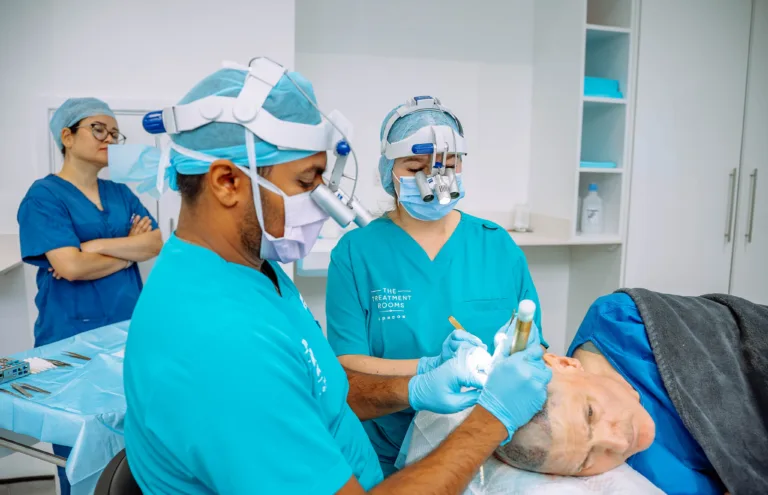
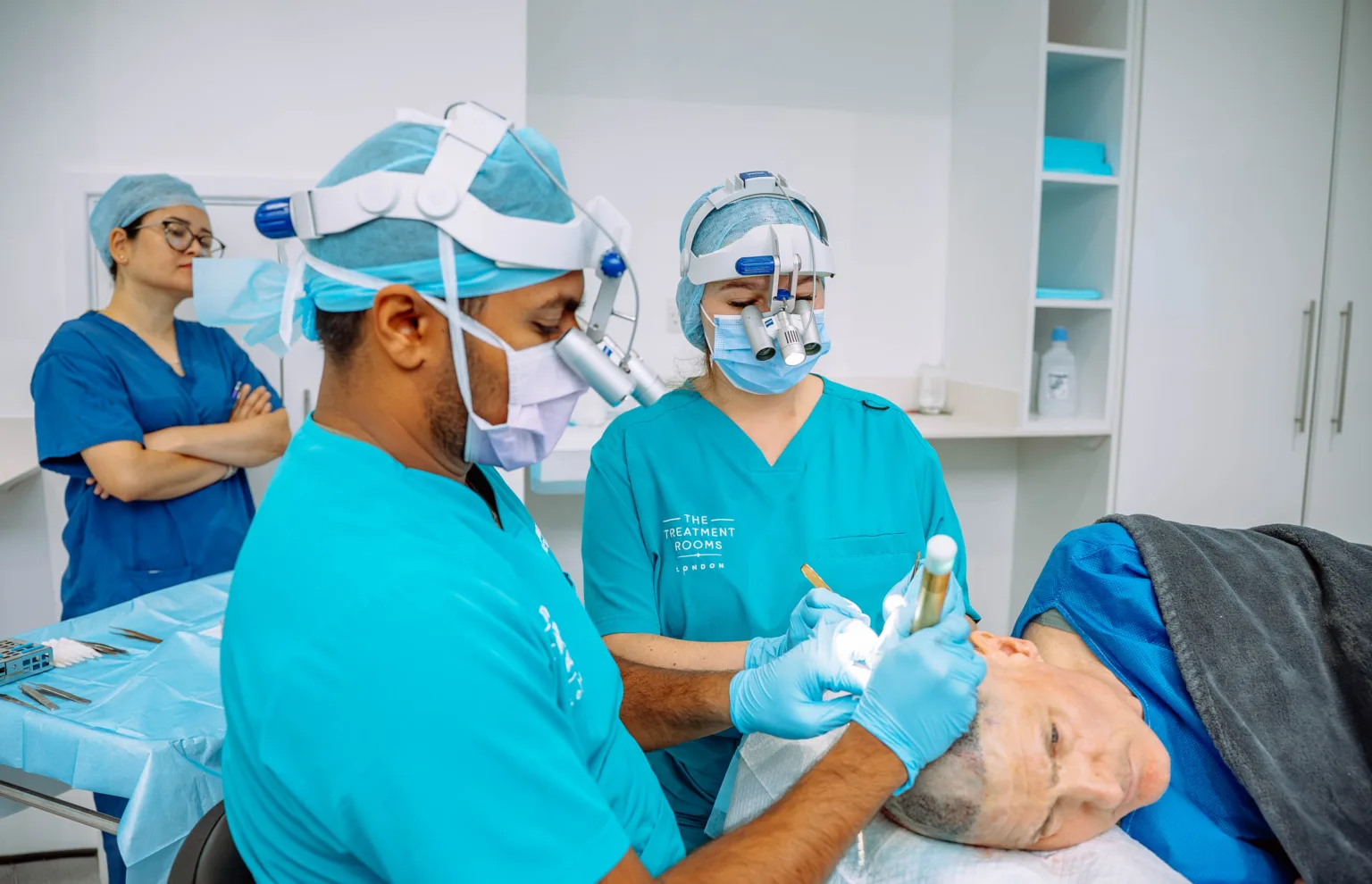
The FUE hair transplant technique is the more modern of the two methods. It takes hair grafts from the back of your scalp as individual follicles. This is done using a specialised instrument which can make tiny punches into the scalp. The grafted hair follicles are then lifted and placed gently in small holes that have been made at the recipient site (where your new hair will grow). This is shown in the video below.
After the process is complete, your scalp will be bandaged for a day or so at the donor site. Expect the transplanted hair to initially fall out, before new hair begins to sprout in about 3 to 4 months. You will likely see a result approaching a final outcome at around 12 months after your operation, and these transplanted hairs are expected to last a long time.
What is a FUT hair transplant?
With a FUT (Follicular Unit Transplantation, or linear strip excision) technique, hair grafts are taken by removing a strip of skin from the back of your scalp. This strip is typically several inches long. Once the site from which the strip was taken (donor site) is stitched up, the strip is then split into smaller sections under a microscope.
These smaller sections are then implanted at the recipient site, and the follicles can begin to settle in and grow, much the same as an FUE. Once transplanted, the hairs will typically fall out before new growth emerges over 3 to 4 months.
FUE vs FUT: What’s the difference?
Now that we’ve outlined how both hair transplant procedures work, the main difference between the two methods is how hair follicles are extracted from the donor area.
In FUE hair transplant surgery, the extraction process leaves small, pinpoint scars scattered along the back and sides of the scalp. This scarring is often concealed, even when hair is cut shorter.
In FUT hair transplant surgery, patients will be left with a linear scar across the back and sides of the scalp, which is concealed when hair grows a little longer, but can be visible if you cut your hair short enough to see your scalp in that area.
Overall Results
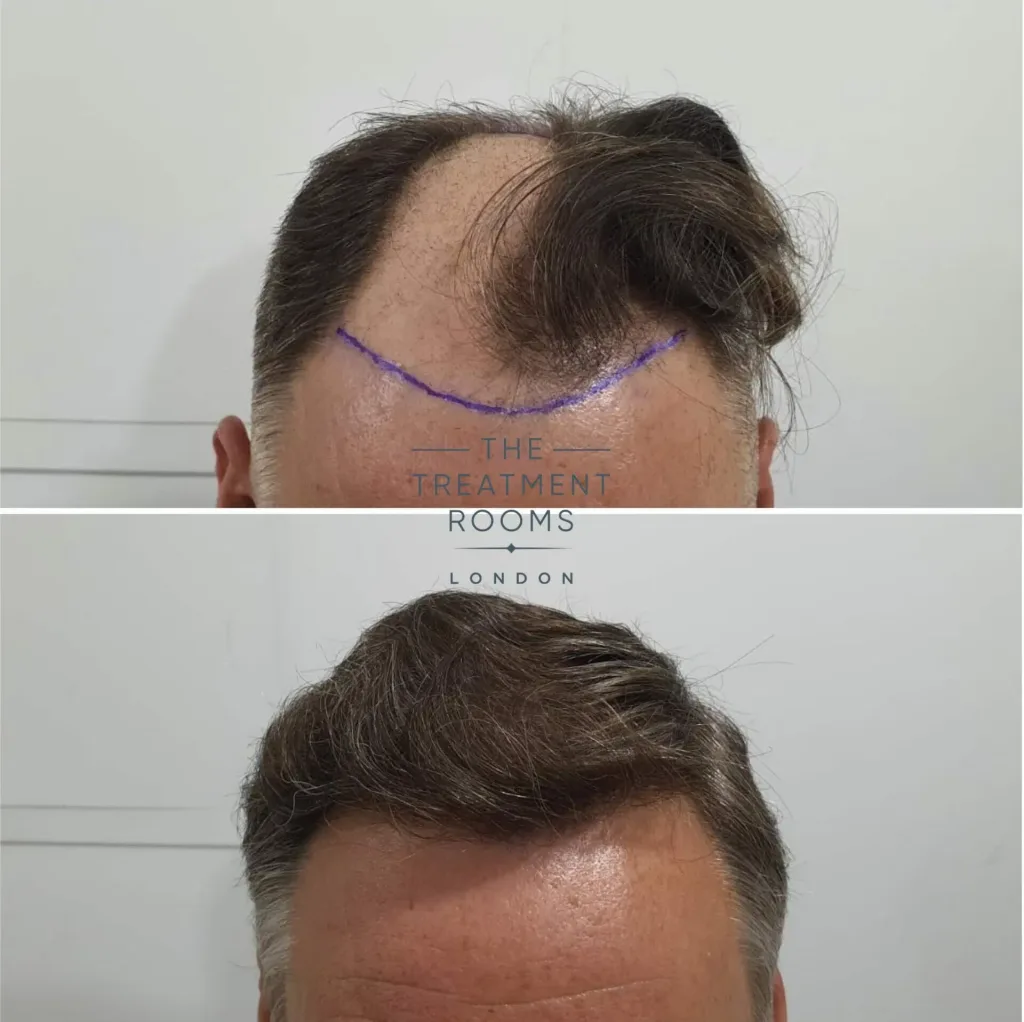
Both the FUE and FUT techniques offer the same results in hair regrowth. This is because the only difference is in how the grafts were taken. The growing process for new grafts remains the same between both procedure types.
However, if a significant amount of grafting is required, the FUT technique can yield more hair grafts for transplant in one sitting, which can allow for more coverage than an FUE procedure. FUE hair transplant surgery can cost a little more than FUT surgery.
Cost
The more modern FUE technique tends to be more expensive than the FUT technique at a majority of hair transplant clinics. How many grafts, and therefore the length of time taken, can also determine the final cost. Patients who require more grafts may find that FUT allows them to stay within their budget, as an FUE is more labor intensive, and as a result, is naturally more expensive for a similar amount of grafts than a FUT.
Take a look at our hair transplant costs page for more information. You can also use our graft calculator page to understand how many grafts you are likely to require for your hair transplant.
Hair Shave Differences
Patients concerned about shaving their hair for surgery should carefully consider hair transplant methods. It is often the case that women and transgender patients who wish to lower their hairline, or feminise their hairline, would prefer to keep their hair long while awaiting the final outcome.
We can perform both unshaven FUE and unshaven FUT hair transplants. However, for patients who want an extensive hair transplant without shaving much hair, an unshaven FUT hair transplant may be preferable to an unshaven FUE hair transplant, especially when it comes to the cost involved.
Recovery Differences
Because the FUT technique is more invasive, recovery typically takes longer. While recovery time is 5 to 7 days with an FUE hair transplant, FUT patients may need 10 to 15 days to resume all normal daily activities. This is mainly because the donor site requires stitching in a FUT procedure and this takes more time to heal.
For more information, please refer to our guide to hair transplant aftercare and recovery.
Success rates
Despite their differences, the success rates of the FUE and FUT hair transplant techniques are similar. The main determining factors of the final results of your hair transplant are more dependent on how well the surgeon performs the procedure, and how well you stick to the aftercare guidance – as opposed to the specific technique that was used.
Is FUE or FUT hair transplant surgery more painful?
Both procedures use local anaesthesia to numb the scalp, so you shouldn’t feel pain during the procedure. It is common for patients who undergo FUE hair transplant surgery to be comfortable after the procedure, with very minimal pain reported, if any at all.
In contrast to FUE, patients who have FUT hair transplant surgery may complain of pain in the donor area that has been stitched. This is common and should largely disappear by the third day after the operation. Patients are given pain-relieving medication to take at home to help reduce this discomfort.
Is FUE or FUT faster to have?
Both techniques can take around 6-8 hours to perform over the course of one day. If you are having a large FUT hair transplant session, then it can take slightly longer to complete, but again, they both will usually be finished within the same day.
Because hair growth timelines are fixed, you can expect to see a full result from both methods within 12-18 months after surgery, so neither is quicker at showing results than the other.
Does FUE or FUT give more realistic results?
Both FUE and FUT hair transplant techniques can give equivalent, realistic results for patients. Although they are harvested in a different way, your grafts will be implanted using exactly the same technique, regardless of whether you have a FUT or an FUE surgery. This means the final appearance will be the same after both procedure types.
The main reason a surgeon will recommend one method over another is usually for practical reasons such as needing a larger amount of grafts. This should be discussed in detail with you at your pre-operation consultation.
Transplant pros and cons
The table below neatly summarises the main pros and cons of each procedure type.
Pros
| FUE Hair Transplant | FUT Hair Transplant |
|---|---|
| Less painful recovery period than FUT | Can be cheaper than FUE |
| No stitches required | The procedure takes less time |
| No linear scarring | Easier to perform larger hair transplant sessions, taking more hair grafts |
| Short hair is possible without a scar being visible | |
| The donor site heals more quickly than FUT |
Swipe
Cons
| FUE Hair Transplant | FUT Hair Transplant |
|---|---|
| Lower yield of hair compared to FUT | Stitches are required |
| More expensive than FUT | Recovery time is longer |
| Larger sections of your scalp (back and sides) will usually need to be shaved | Healing time is longer |
| A more time-consuming procedure than FUT | The recovery period is less comfortable |
| There is the possibility of visible scarring | |
| Scars require longer hair to cover them |
Swipe
Which hair transplant technique is best for me?
Every patient will have different needs. That’s why the team at The Treatment Rooms London is here to help. Our surgeons offer a wealth of experience in performing FUE and FUT hair transplant surgery. They can provide you with detailed counselling for both surgeries and determine which option is best for your requirements.
We offer a consultation so you can meet us in person and ask any questions you may have. We’ll evaluate your scalp to determine how many grafts you will need for the procedure, and discuss what the best technique is for you.
Take peace of mind from the expert level of care provided by The Treatment Rooms London’s experienced hair transplant surgeons.
Explore our extensive gallery of hair transplant results, where you can view a wide range of before and after transformations.
With each case, you can have a glimpse at how we have helped hundreds of people like you achieve their dream hairline, often just from a single day procedure.
Furthermore, our patient journey is second to none, with hair transplant aftercare factored into our pricing structure.
For more information about costs associated with an FUE hair transplant, take a look at our dedicated hair transplant cost page or try our hair graft calculator to figure out how many grafts you might need.
Get in touch today if you’d like to book a consultation to discover how our team may be able to help you achieve a fuller, natural finish to your hairline.
References
Referenced in this article
1
Rassman WR, Bernstein RM, McClellan R, Jones R, Worton E, Uyttendaele H. Follicular unit extraction: minimally invasive surgery for hair transplantation. Dermatol Surg. 2002;28(8):720-8. doi:10.1046/j.1524-4725.2002.01320.x International Society of Hair Restoration Surgery. A guide to hair transplant
https://www.google.com/
2
International Society of Hair Restoration Surgery. A guide to hair transplant surgery [Internet]. Geneva (IL): International Society of Hair Restoration Surgery; [cited 2026 Oct 2]
https://ishrs.org/patients/treatments-for-hair-loss/surgical-treatments/?utm_source=chatgpt.com
(cited October 2, 2026)
3
Jiménez-Acosta F, Ponce-Rodríguez I. Follicular unit extraction for hair transplantation: an update. Actas Dermosifiliogr. 2017;108(6):532-7. doi:10.1016/j.ad.2017.02.015
https://www.google.com/
4
Gupta AK, Love RP, Harris JA. Old friend or new ally: a comparison of follicular unit transplantation and follicular unit excision methods in hair transplantation. Dermatol Surg. 2020;46(8):1078-83. doi:10.1097/DSS.0000000000002373
https://www.google.com/
5
Kim YS, Na YC, Park JH. Comparison of postoperative pain according to the harvesting method used in hair restorative surgery. Arch Plast Surg. 2019;46(3):241-247. doi:10.5999/aps.2018.00843
https://www.google.com/